

Think of industrial robots as highly skilled workers reshaping the manufacturing landscape. They incorporate advanced components like sensors, controllers, and actuators—all mounted on flexible joints and links to form precise robotic arms. What sets these machines apart is their ability to automate repetitive, continuous tasks while adapting to new instructions seamlessly. By executing programmed instructions, they reduce—or even eliminate—human intervention, boosting production speeds and product consistency. Today, industrial robots tackle everything from automotive assembly to precision-based roles in medical device creation, proving their versatility across industries.
Core Components of Functioning Industrial Robots
There are over a million dangerous or repetitive tasks modern manufacturing teams can’t efficiently handle without industrial robots – these systems simultaneously boost productivity while improving product consistency. Their secret lies in five key components working together:
- The Controller: This specialized computer acts as the robot’s brain, processing inputs and directing all operations through programmed instructions.
- The Robotic Arm: Featuring base, shoulder, forearm, and wrist sections connected by motor-driven joints, it offers human-like dexterity through multiple planes of movement.
- The End-Effector: From vacuum grippers to welding torches, these customizable “hands” directly interact with workpieces to complete specific tasks.
- The Sensors: Vision systems and force detectors serve as robotic senses, enabling real-time environmental awareness for precise material handling.
- The Drive System: Hydraulic, electric, or pneumatic power sources create the motion needed for industrial robots: what they are in physical terms and how they work through kinetic energy conversion.
The controller’s processing power translates to operational intelligence – it monitors joint positions while coordinating the arm’s movements. Three critical sections (base, shoulder, and forearm) connected by rotary and linear joints enable spatial flexibility through 6+ degrees of freedom. Want proof of this flexibility? Automotive assembly bots can simultaneously rotate door panels while maintaining perfect alignment during installation sequences.
End-effectors turn motion into action through task-specific attachments. Manufacturers frequently design custom grippers for unique challenges, like handling 150°C metal castings without compromising precision. These tools work closely with sensor arrays – cameras capture object positioning while force-torque sensors ensure proper grip strength when manipulating delicate glass components.
Power transmission comes in three forms:
- Hydraulic Drive: Best for heavy payload applications exceeding 500kg
- Electric Drive: Ideal for cleanroom environments requiring precise motion control
- Pneumatic Drive: Cost-effective solution for high-speed picking operations
As production managers know, choosing components involves balancing these mechanical building blocks. The true magic emerges when synchronized controllers, articulate arms, and task-driven end-effectors combine.
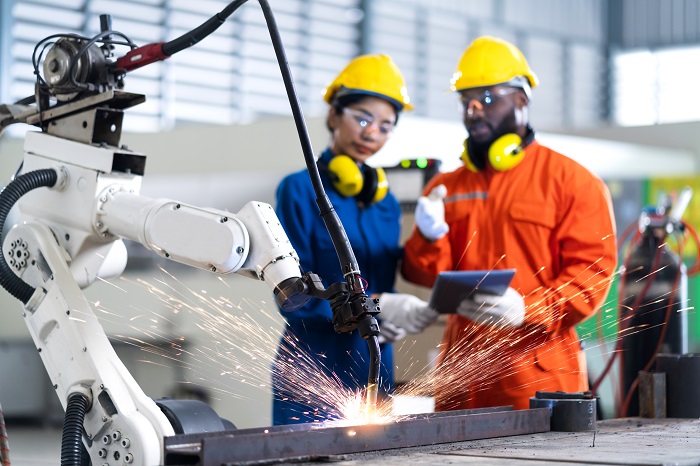
Types of Industrial Robots: What They Are and How They Work
Not all industrial robots are identical—they come in different configurations designed for specialized manufacturing tasks, similar to dedicated artisans in a workshop. These variations stem from their mechanical configurations—the arrangement of joints and links within their arm structures dictates their movement capabilities and industrial applications. Let us examine six prevalent industrial robot classifications:
Cartesian Robots: Employing three linear, sliding mechanisms, cartesian robots move along the X, Y, and Z axes—imagine three-dimensional graph paper brought to life. This design makes them ideally suited for tasks requiring consistent, straight-line motion, such as CNC machining, 3D printing, and pick-and-place operations in packaging.
Articulated Robots: Featuring human-arm-like flexibility, articulated robots excel in applications demanding multi-axis dexterity. These versatile systems are widely utilized in automotive manufacturing for arc welding, precise painting, and materials handling.
Cylindrical Robots: Combining a rotational base joint with linear actuators, cylindrical robots operate within a cylindrical work envelope. This configuration allows them to access confined spaces while maintaining speed and precision, often used in simple handling, rotating, and placing material.
SCARA Robots: SCARA (Selective Compliance Assembly Robot Arm) robots feature two parallel joints, providing compliance in a single plane. This design makes them perfect for quick, precise pick-and-place tasks, excelling in applications like electronics assembly and intricate parts transfer.
Delta Robots: With three arms connected to a common base, delta robots offer unparalleled high-speed, lightweight manipulation. Their design is typically employed in the food industry or pharmaceutical packaging, where they are used in high-speed sorting and packaging.
Polar Robots (Spherical Robots): Utilizing two rotary joints and one linear joint, polar robots operate within a sphere-shaped workspace. They operate to provide a very flexible wide reach. This makes them applicable for die-casting.
Understanding these fundamental robot types and configurations forms the cornerstone of strategic automation.
Read More : AI-Powered Quality Control: The Next Frontier in Manufacturing Excellence
How to Select the Right Industrial Robot for Enhanced Productivity
Today, factories face transformative automation decisions shaped by Industry 4.0’s 5G networks and IoT-enabled collaborative robots. Industrial robots: what they are and how they work become vital when applying the Three D’s rule (Dirty, Dull, Dangerous) – your compass for identifying hazardous material handling, tedious assembly lines, and injury-prone tasks needing automation.
This methodology directly yields:
- Enhanced Productivity: Faster cycle times with AI-driven machine vision systems
- Safer Work Environments: Elimination of manual errors in dangerous tasks
- Consistent Product Quality: Precision through robotic welding and cutting
While reducing manufacturing costs, thoughtful integration preserves employee security through upskilling programs.
Industrial Robotics Applications and Future Trends
Understanding industrial robots: what they are and how they work starts with recognizing their critical role across industries, from the Automotive Industry to the Healthcare Industry and Electronics Industry. These automated systems now power smart production lines where Collaborative Robots (Cobots) work alongside humans in Industry 4.0-enabled Smart Factories.
As 5G networks and AI accelerate robotic capabilities, your ability to adapt to these technological shifts directly impacts career readiness in advanced manufacturing. Emerging trends reveal the following transformative shifts:
Smart Material Handling: Automated guided vehicles now move faster in the Logistics sector while sensors prevent collisions.
Hyper-Precise Programming: Modern robotics coding platforms allow real-time adjustments to robotic arc welding paths with high accuracy.
Human-Machine Synergy: Force-limited arms from Cobots enable safe machine tending without safety cages in the Electronics assembly.
The rise of mobile AI platforms creates urgent demand for Robotics Programming specialists who can optimize automated paint spraying systems one day and configure palletizing robots with machine vision the next.